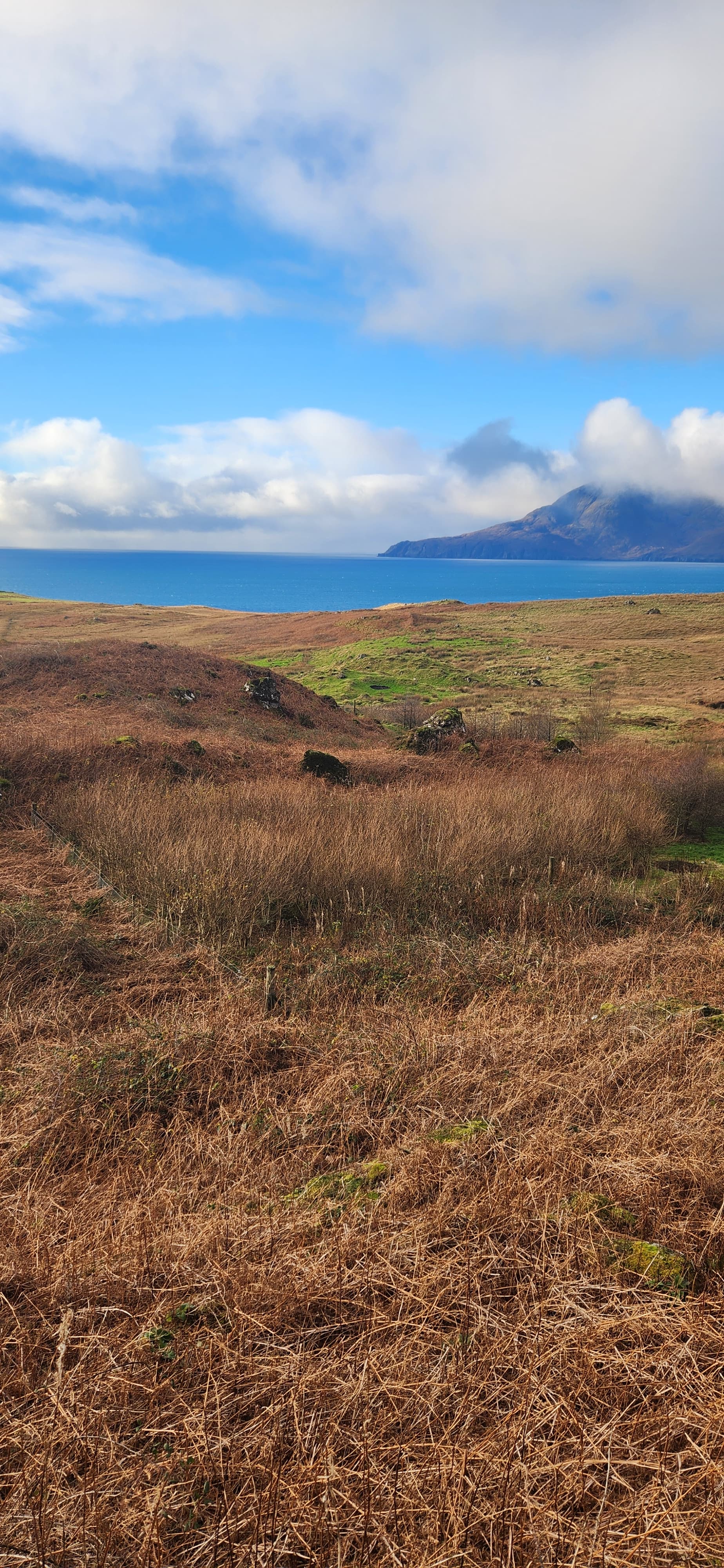
On their tenanted croft on the Isle of Eigg, basketmakers Pascal Carr and Catherine Davies have two quite different ways of growing rods. One is a 0.3 hectare commercial willow coppice with 5,000 stools, the other is a 0.1 hectare Atlantic rainforest hazel plantation, grown from local stock.
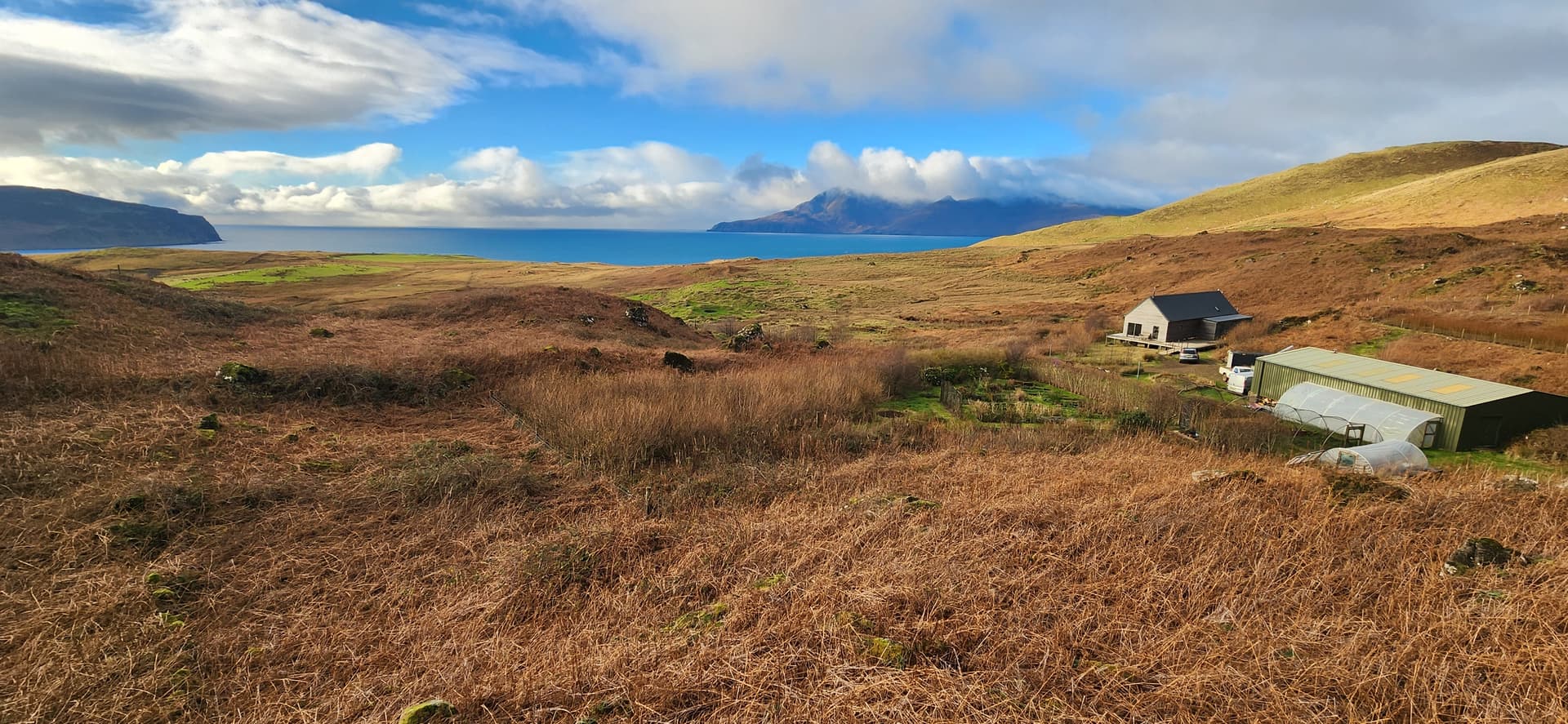
The basketry willow is coppiced annually to provide all the material for their basketmaking business All About Willow for both teaching and selling. The main product is dried willow for basketmaking. This coppice is run on a commercial basis and now harvested mechanically, with the 5,000 stools producing about 1 tonne of dry willow per year.
The Eigg native Atlantic rainforest hazel woodland, meanwhile, was inspired by Sandy and Brian Coppins’ book Atlantic Hazel,[1] and aims to create habitat, with materials for personal use such as basketry rods, garden supports and firewood a secondary bonus. “Our main objective was to recreate Atlantic rainforest hazel with a new planting,” says Catherine. “And to see if associated species (like fungi, mycorrhizal fungi and lichens) would colonise from existing local hazel stands.”
The first rods were harvested in 2025. The plan is that no clear cutting will be done; instead individual rods will be taken as required, mainly for basketry use. This selective cutting allows regrowth in line with natural growth patterns.
Set-up
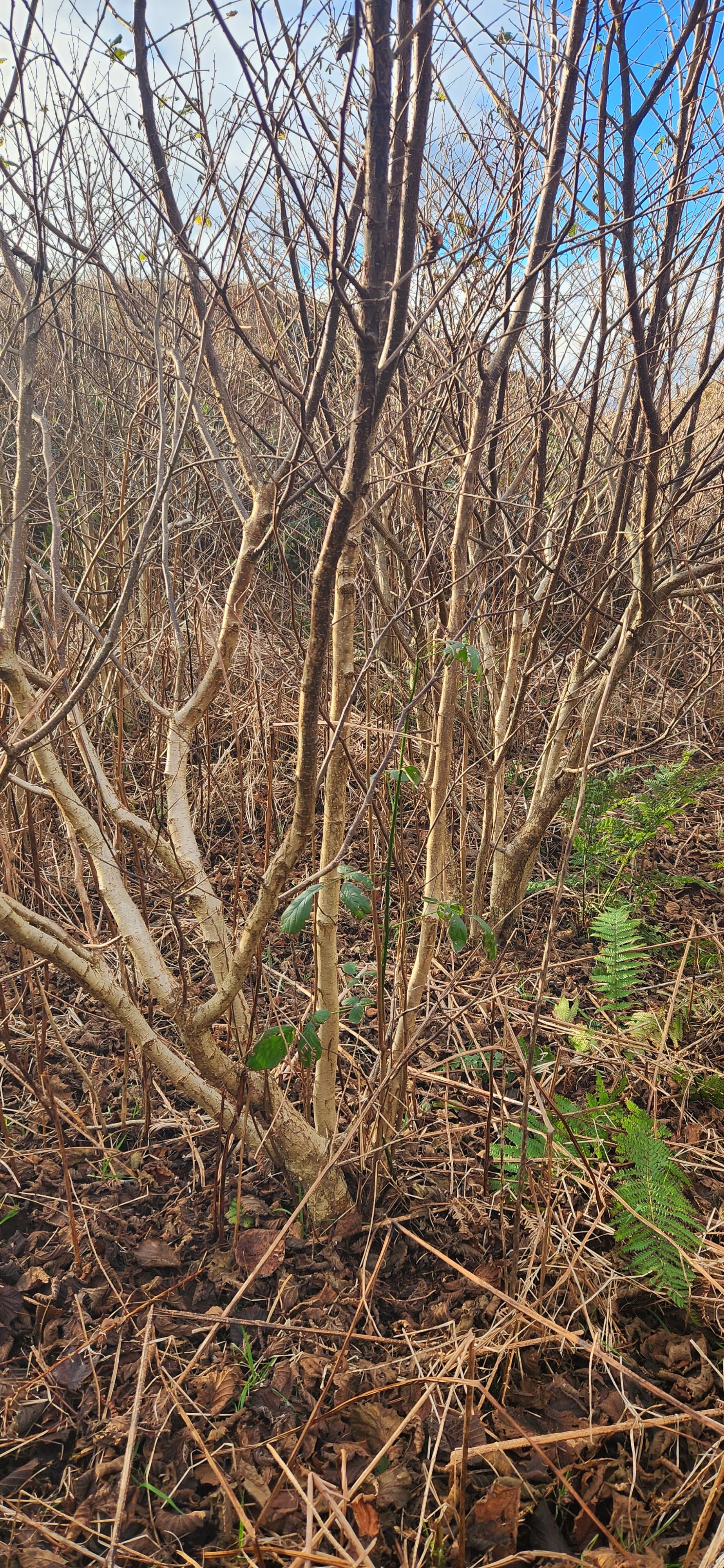
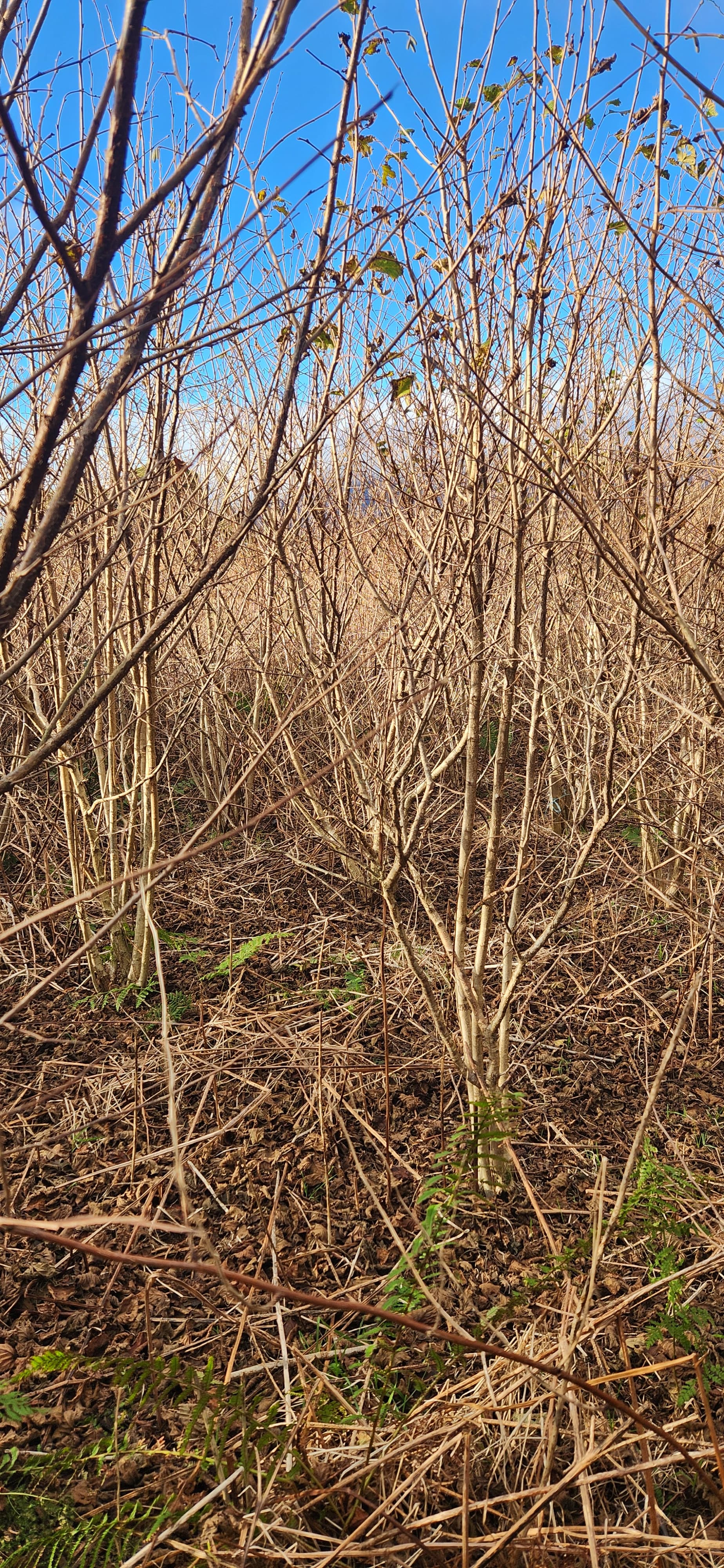
The basketry willow coppice was started in 2009, with additional plantings in 2010 and 2015 to 2018, and is now 16 years into the rotations. The 30cm-long cuttings were planted 30cm apart in the row, with 70cm between rows. This row spacing allows for mechanical harvesting and access for bundling cut willow between rows.
The species mix includes Salix purpurea, Salix alba, Salix viminalis, Salix triandra, Salix daphnoides and several hybrids. “The willow varieties that we grow are driven by the baskets that we want to make,” says Pascal. “Catherine fell in love with traditional West Coast work baskets – creels etc. – learning from Joe Hogan in Ireland who also grew the robust willow varieties needed and in the same climate. Our original cuttings came from Joe, but since then the range of baskets that we wanted to make has expanded and so we planted different varieties to suit this finer, more contemporary work.”
For the initial set-up in 2009 the field was fenced against stock and rabbits and the surface vegetation raked off to leave exposed soil surface. A woven horticultural membrane was then laid, pegged and weighted against wind lift. The cuttings were planted through membrane and first coppiced in 2010.
Luckily, there are no deer on Eigg so a rabbit-/stock-proof fence was enough. The main difficulty with pests was from voles bark ringing under the membrane. Some minor aphid damage occurred during the growing period, but there were no other pest and disease problems.
The Atlantic rainforest hazel project began in February 2015 when Catherine and Pascal were given two- to three-year-old local provenance hazel seedlings. The seedlings were transplanted as bareroot plants into nursery beds for two further years. The spacing when planted out in their final position was 1.5 metres between trees, similar to local native stands on the croft and beyond. Catherine and Pascal try to stimulate colonisation by symbiotic organisms by introducing dead material and green offcuts from established stands, i.e. throwing sticks into the plot.
Working it
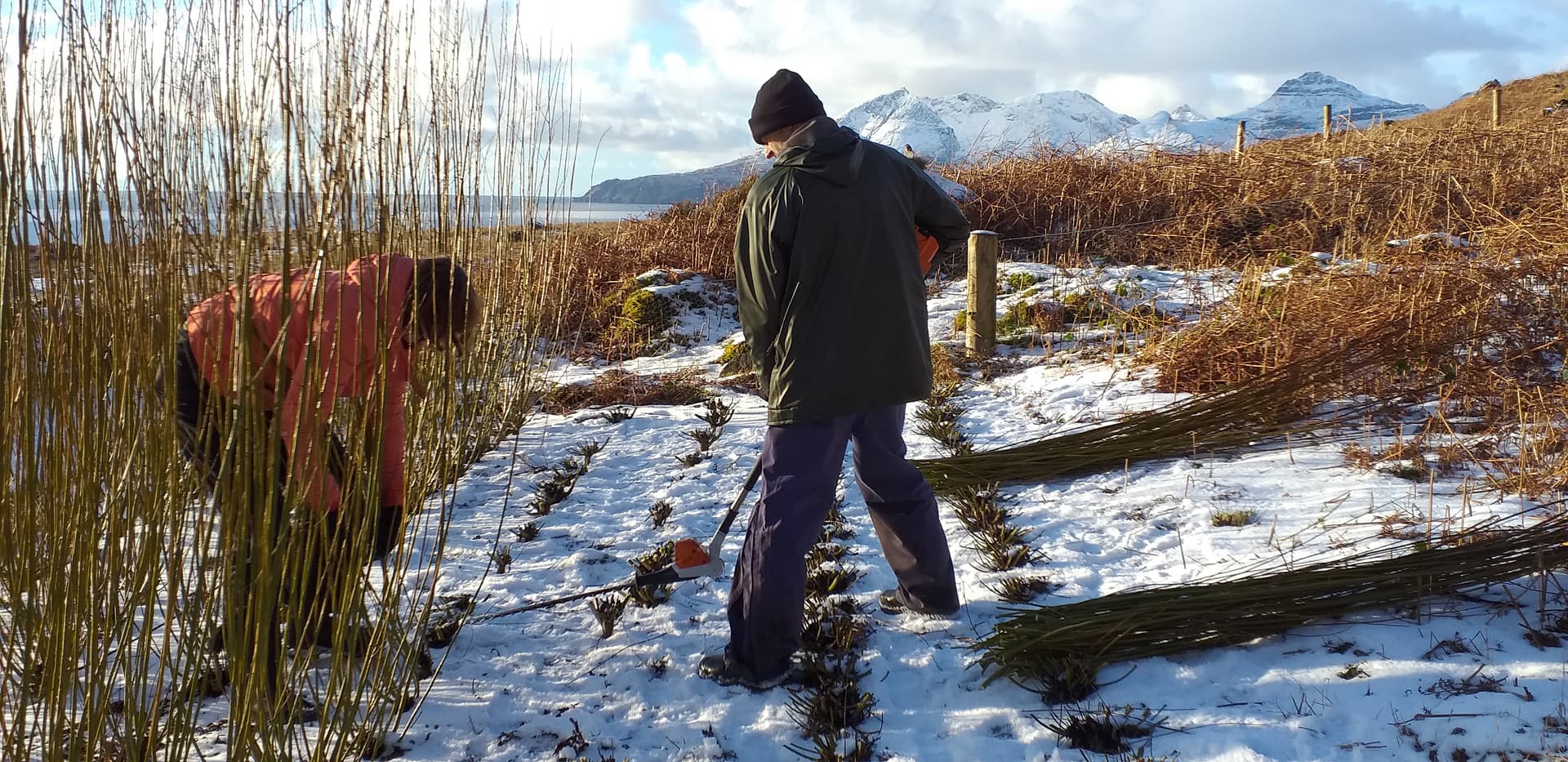
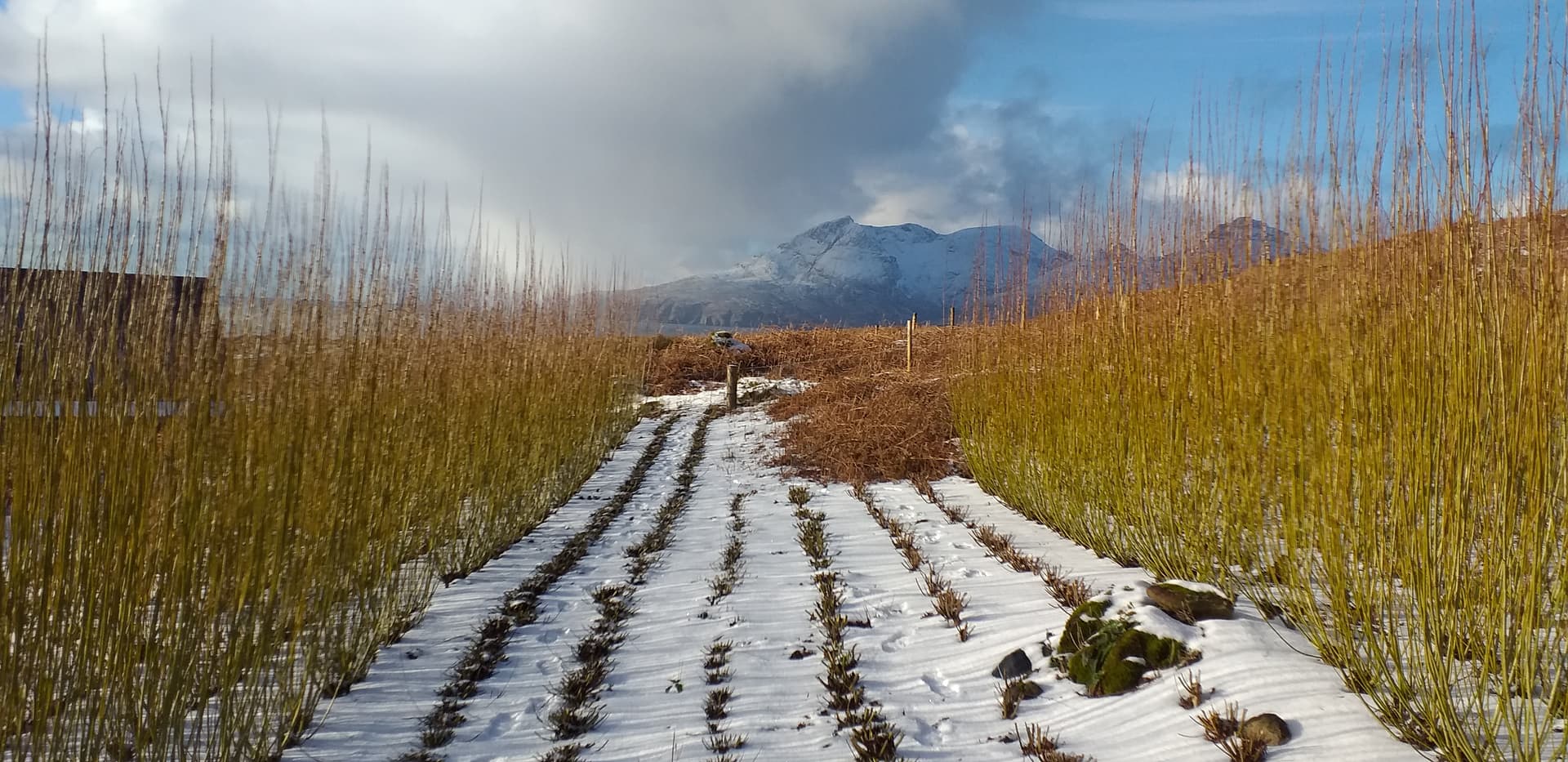
The basketry willow averages 50 to 70 rods per stool at peak, with peak harvests from about year 5 to 10 (both maximum number of rods and rod diameter). After a decade the vigour of a stool decreases, and Catherine and Pascal aim to succession plant with new cuttings at year 7 to allow for a three-year lead time.
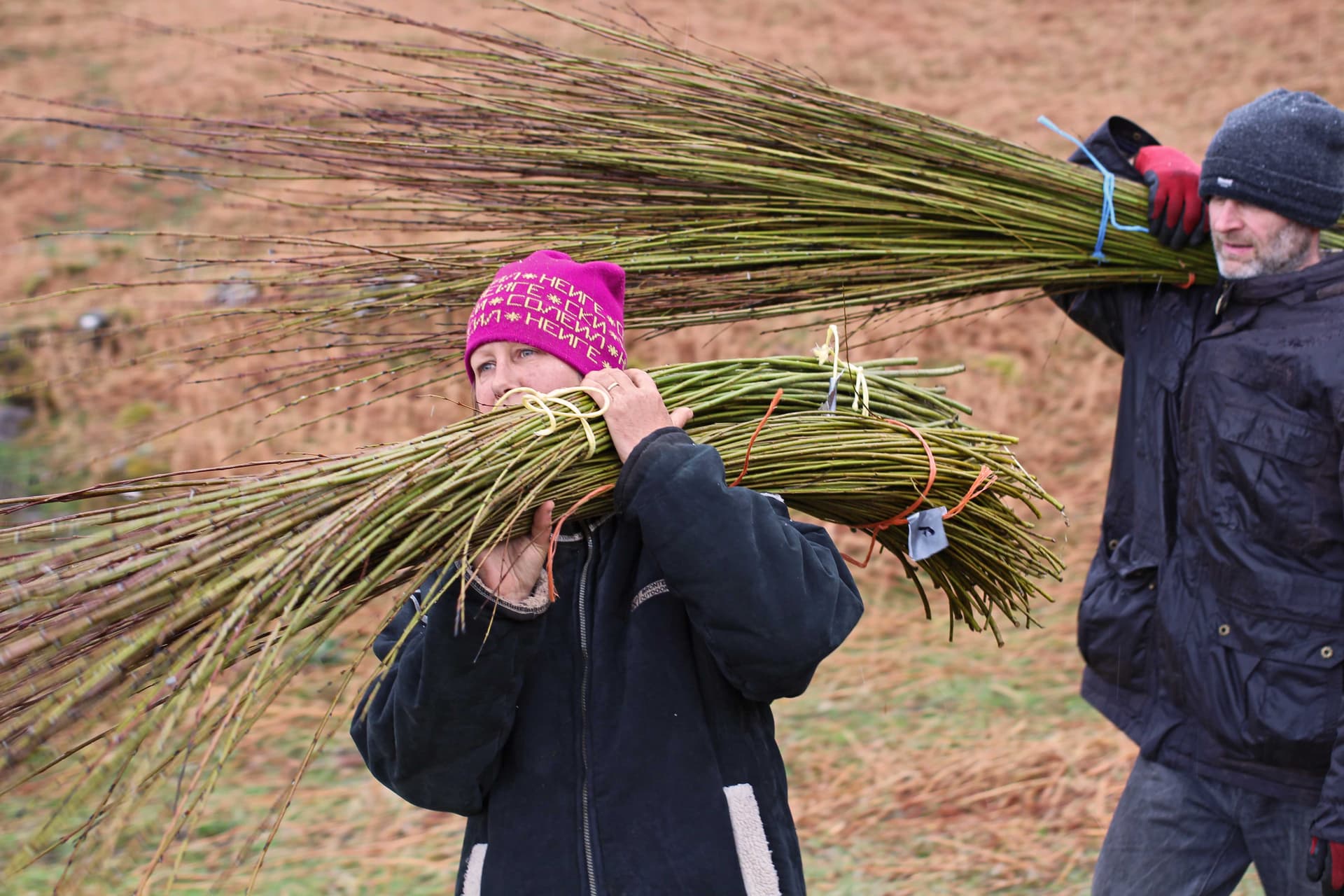
Their 5,000 stools produce about 1 tonne of dry willow annually, but the green willow is significantly heavier so physical access for collection has to be considered. Cut willow can be racked in the field, off the ground, for four to six weeks. However, it must be brought under cover before shrinkage of the rods begins. Good air circulation is helpful for drying. Cut rods are sorted to length, either green or after drying. This is easier dry as they don’t weigh as much.
Up until 2021 Catherine and Pascal coppiced everything with hand tools – secateurs and loppers. Since then they have used a Stihl cordless long-reach hedge trimmer to make life a little easier and some hand cutting for bigger material. Mostly everything is done using their own labour, with some volunteers as necessary. No other machinery is used.
For manual harvesting, the first-year willow growth is hand cut flush with main stem plus removal of any die-back, using secateurs. This will give a stool height of about 10cm. Top growth in the first year is limited since the newly planted cutting spends much of its energy growing roots. The second-year growth is again hand cut using secateurs; some usable rods will be produced. In the third year and beyond, Catherine advises: “Continue to hand cut as mental will and physical ability allow.”
The advantages of hand cutting are that this forms a smooth, rounded stool head, which minimises die-off due to fungal disease, and it only needs one person at a time.
Mechanical harvesting can be done using reciprocating blades – rotavator-mounted or hand-held – or a fine-toothed circular blade on a brush cutter, but this all needs two people – one to do the cutting and one to hold the bundle of willow to stop the rods falling back into the cutting blades.
The number of hours taken to harvest the willow can be halved with mechanical harvesting, but the total number of person-hours is about the same as with hand cutting. The stool head will have many short rod ends which causes the stool head to spread widely and creates pockets where leaf debris collects and encourages fungal diseases to infect the stool.
Willow is cut during dormancy, after leaf fall. “Up to 10 years ago this would have been about December to early April where we are off the north-west coast,” says Catherine. “Now we have to finish cutting by the end of February as some varieties are beginning to leaf a month earlier. We think this is an indicator of climate change.”
For the hazel, smaller diameter rods are cut using secateurs or loppers and larger material is cut using a Stihl cordless chainsaw.
Brash, for both willow and hazel, is handled in several ways: Some is chipped for ramial wood chip, which is either composted or applied directly, some is turned into plant supports and the rest is burnt at Solstice bonfires.
Lessons learnt
“What we have realised is that harvesting commercial willow requires additional labour to do it right,” says Catherine. Cleaning stools up after mechanical harvesting is especially important. The long-reach hedge trimmer leaves ragged rod ends on stool, and these should be trimmed back to the stool surface if time and will allow.
For the hazel, Catherine and Pascal would increase planting spacing to 2 metres next time as the take was almost 100%. They would also cut wavy rods earlier to encourage more straight growth and make it easier to harvest in the future.
Future vision
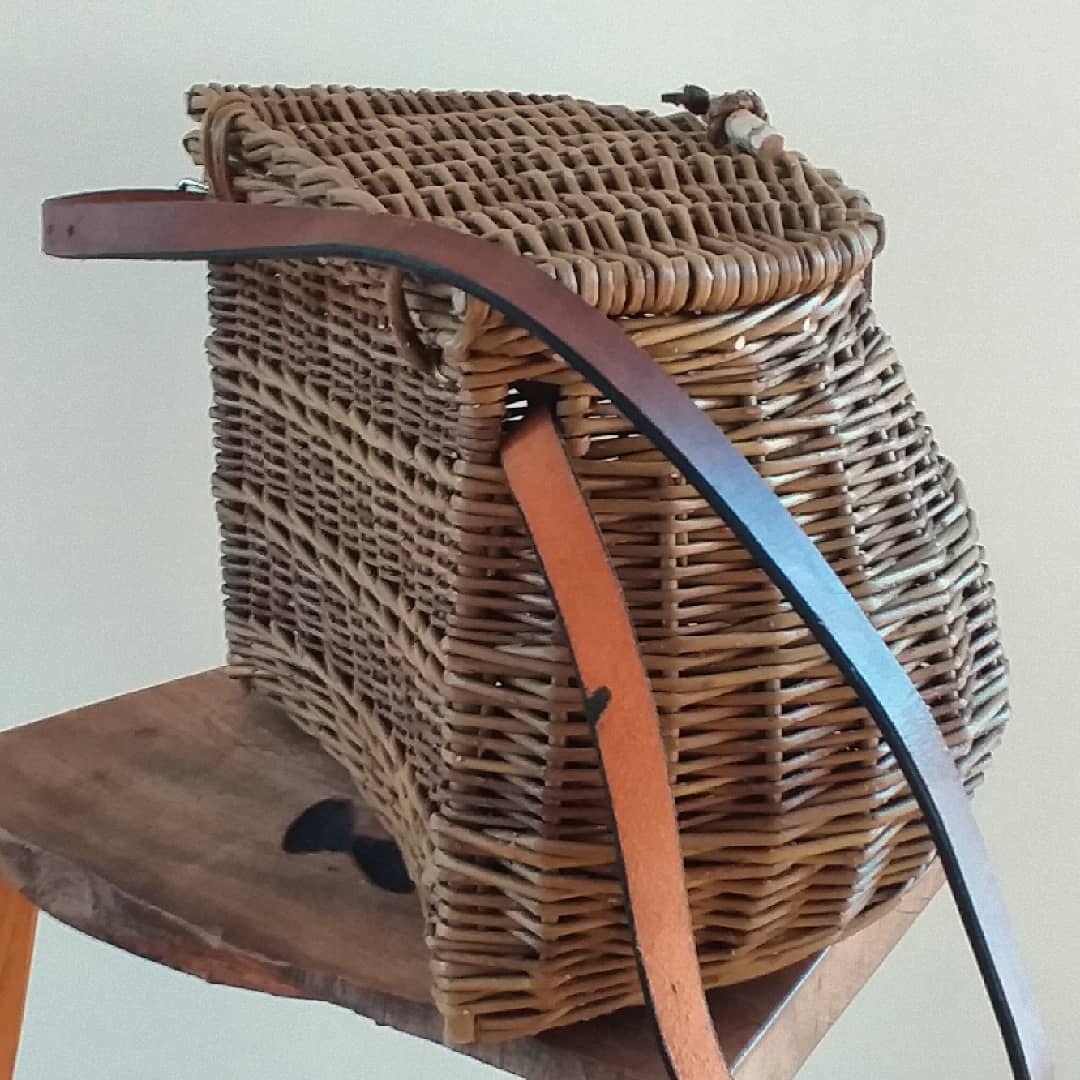
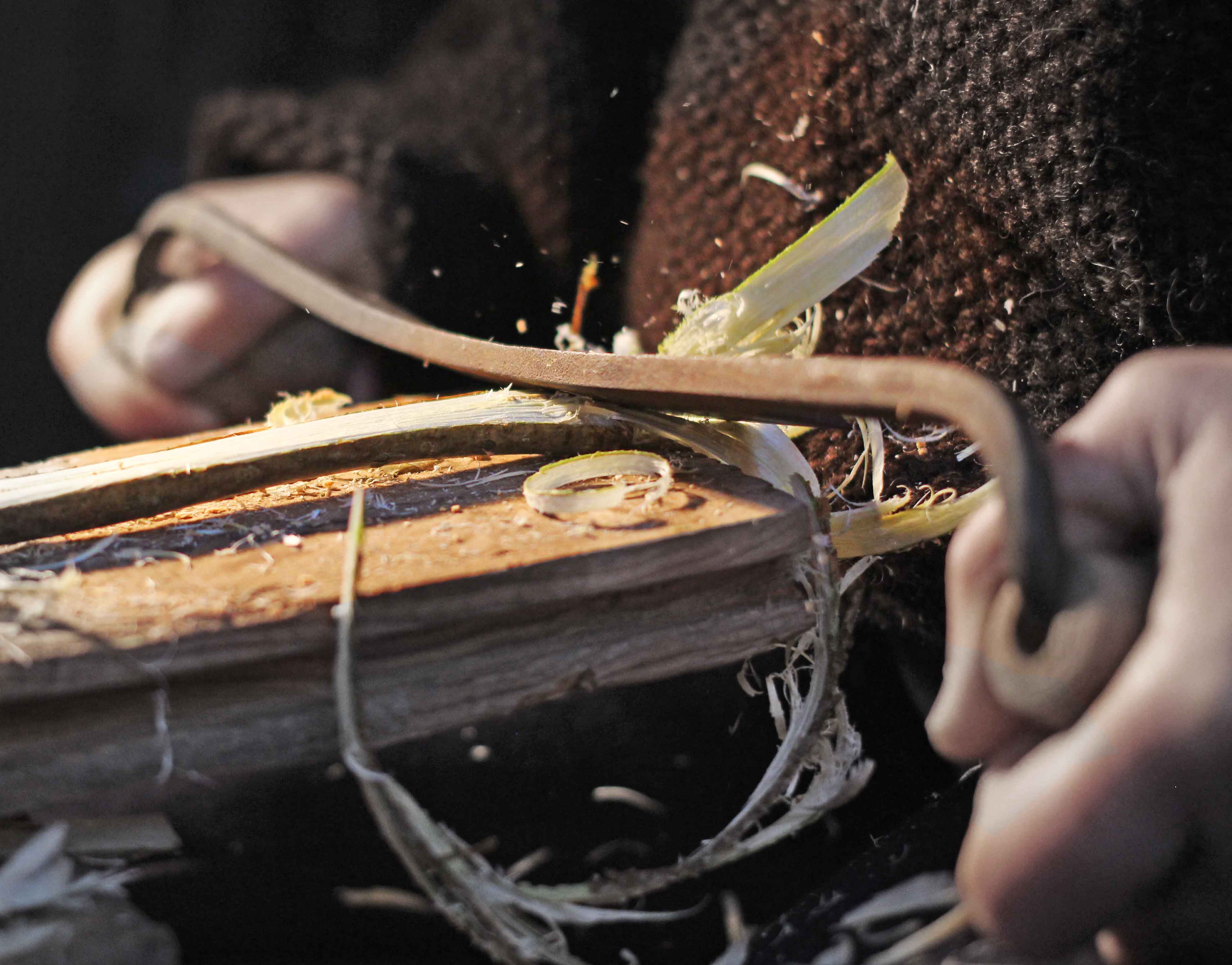
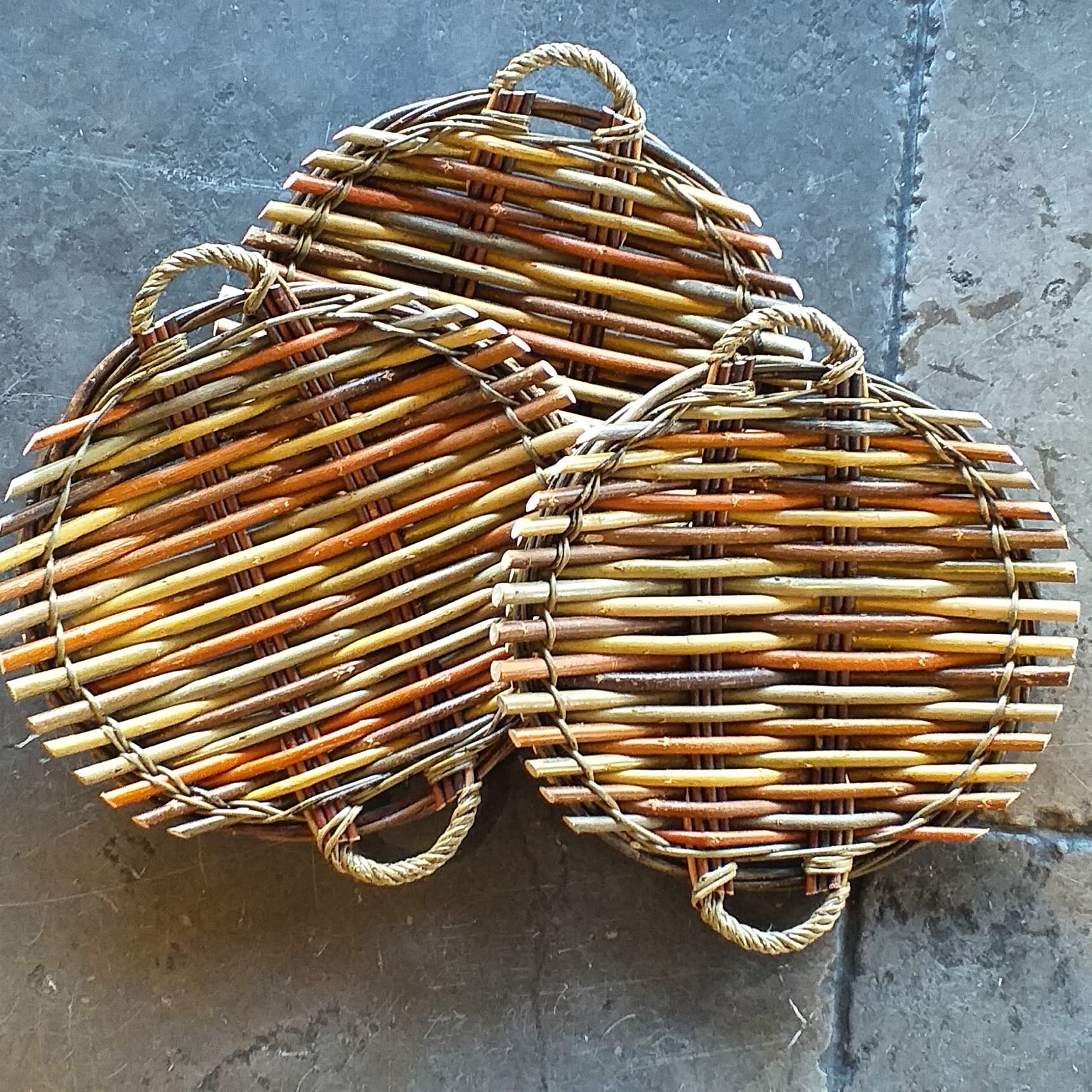
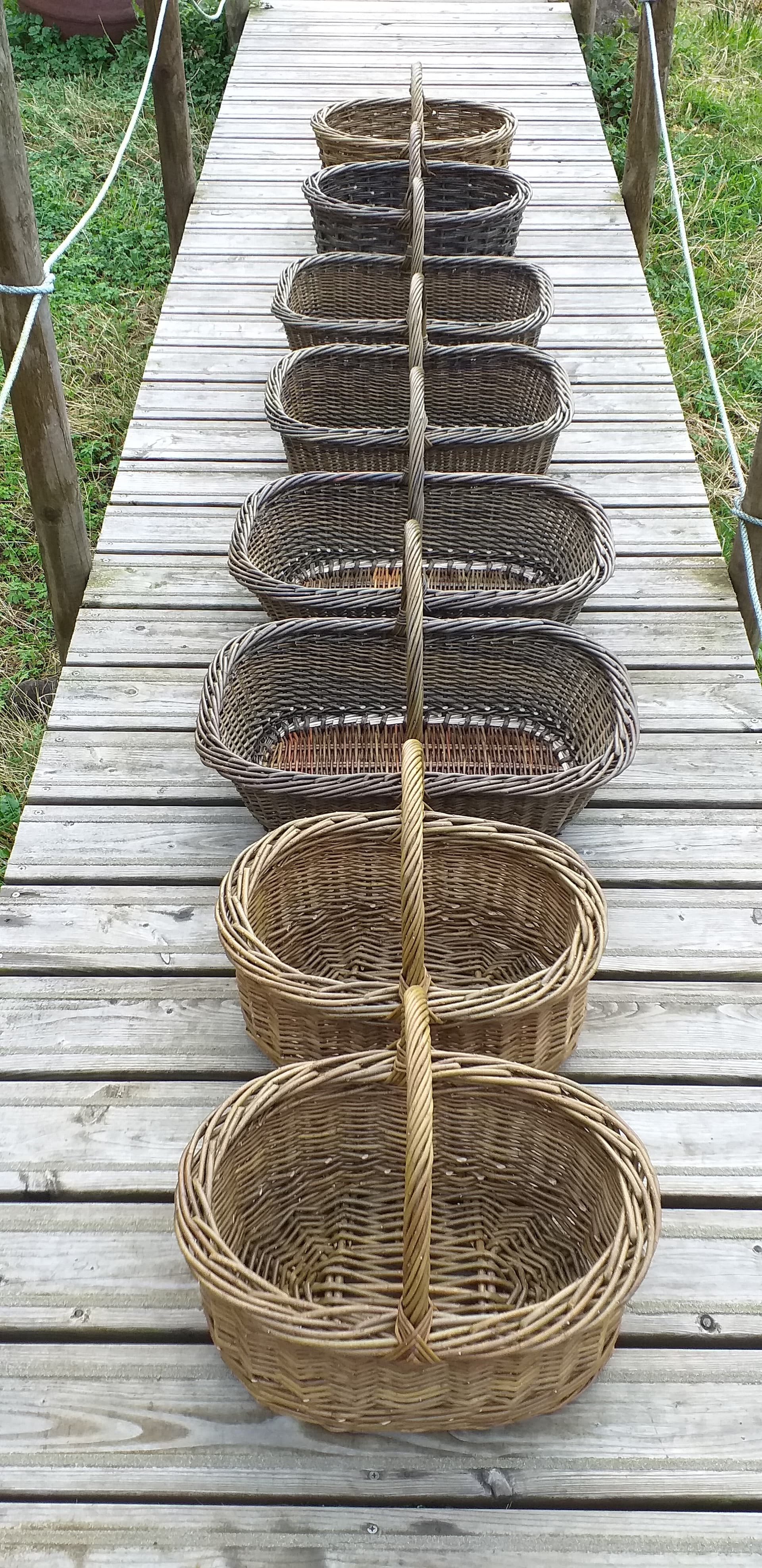
Their vision for the future is to “keep plodding away”, jokes Catherine. Some of their willow will still be viable for a while, but the likely lifespan is 20 years before restocking. They also aim to sell more dried basketry willow instead of using it for making and do more teaching to pass on their skills. For the Atlantic rainforest hazel, they plan to continue to harvest selectively and monitor for colonisation by symbiotic organisms.
Reference
[1] Coppins, Sandy and Brian. Atlantic Hazel: Scotland’s Special Woodlands. Atlantic Hazel Action Group; 2012.
Contact Details
If you wish to comment or ask about any details of the case study, please post a reply below and we will notify the author if they don’t spot it, so that we can all benefit from the learning. You can also contact Catherine and Pascal via their website:


Coppice Case Study Project
This case study is part of Reforesting Scotland’s Coppice Case Study Project, which aims to map out Scotland’s coppice woodlands and share knowledge by publishing case studies. You can read more about the project and other case studies here.